
“Any good news yet?” asks the relative who’s cornered you at a wedding. It’s a question Tamil women hate hearing.
PUNISHING TALK
This relative, whom you barely know, is asking if you’re “finally” with child. Women tell us this question baits them publicly and sinks them emotionally, especially for those navigating infertility.
The room narrows and all the joy of the day, from getting your saree pleats just perfect that morning, to the smell of jasmine flowers weaved into braids, to the taste of sweet palagaram in your mouth, vanishes.
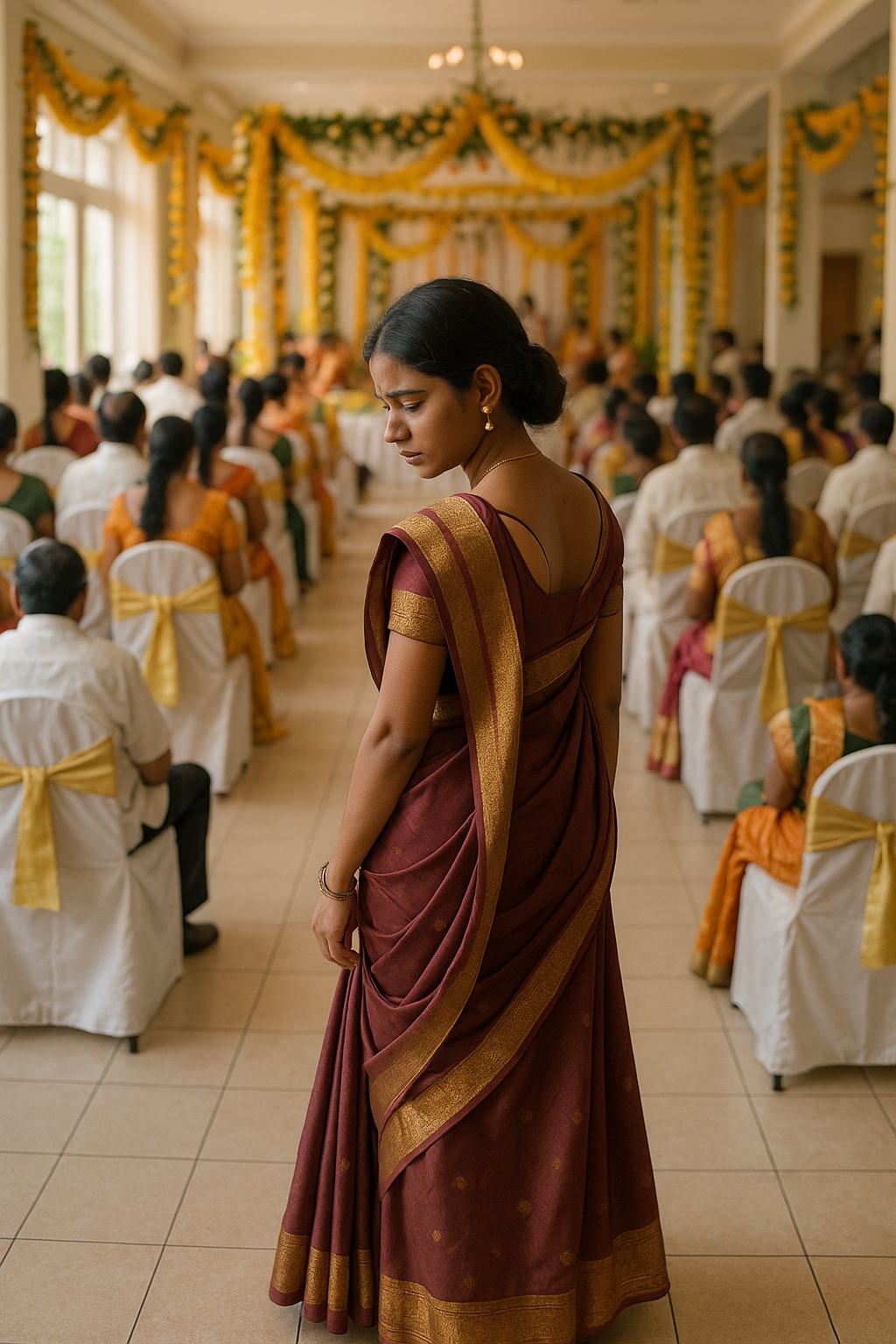
I would dread going to family events, fearing the covert and overt comments about the ticking clock,” writes Lavana*, a woman who battled infertility for four years, describing it as one of the darkest times of her life. “It was easier to stay silent.”
Lavana* was one of many women who wrote in to us, at Tamil Women Rising, in response to our call for stories about navigating fertility and infertility. So did Sarika*.
Facing infertility is already really difficult,” she wrote. “So it becomes so much harder when society also adds on to that pressure by simply asking: Do you have kids? Do you want kids? You’ve been together for so long, why don't you have kids?
Women told us they have many questions about fertility and work:
Have we been trying long enough? What are my options? How much should I set aside financially for this journey? Where, pray, are the resources?
Will my workplace pay for me to freeze my eggs? Will they accommodate my daily injections? Will I get time off after a miscarriage? What kind of fertility benefits could they offer, what should they offer?
Tamil Women Rising wants to help you find answers.
FERTILITY AND THE WORKPLACE
According to medical statistics, the peak fertility age for women is late teens to late 20s. Fertility rates start to drop dramatically after the age of 30 and decline rapidly after 35. The median age of women having their first child in Canada is 31.6 years.
It means women are having children later in life and at the age when more opportunities open up at work. So a lawyer with the Tamil Bar Association may ask herself: "If I slow down now, will I miss out on the path to making partner?" A hospitality worker attending events at the Canadian Tamil Professional Association may worry about navigating the demands of fertility, pregnancy and parenting around shift work. A public servant with Tamils in Public Service may hesitate to apply for that leadership role.
Balancing career and motherhood, especially when fertility is part of the journey, may mean juggling deadlines, running off to medical appointments, smiling through meetings, all while holding onto hope.
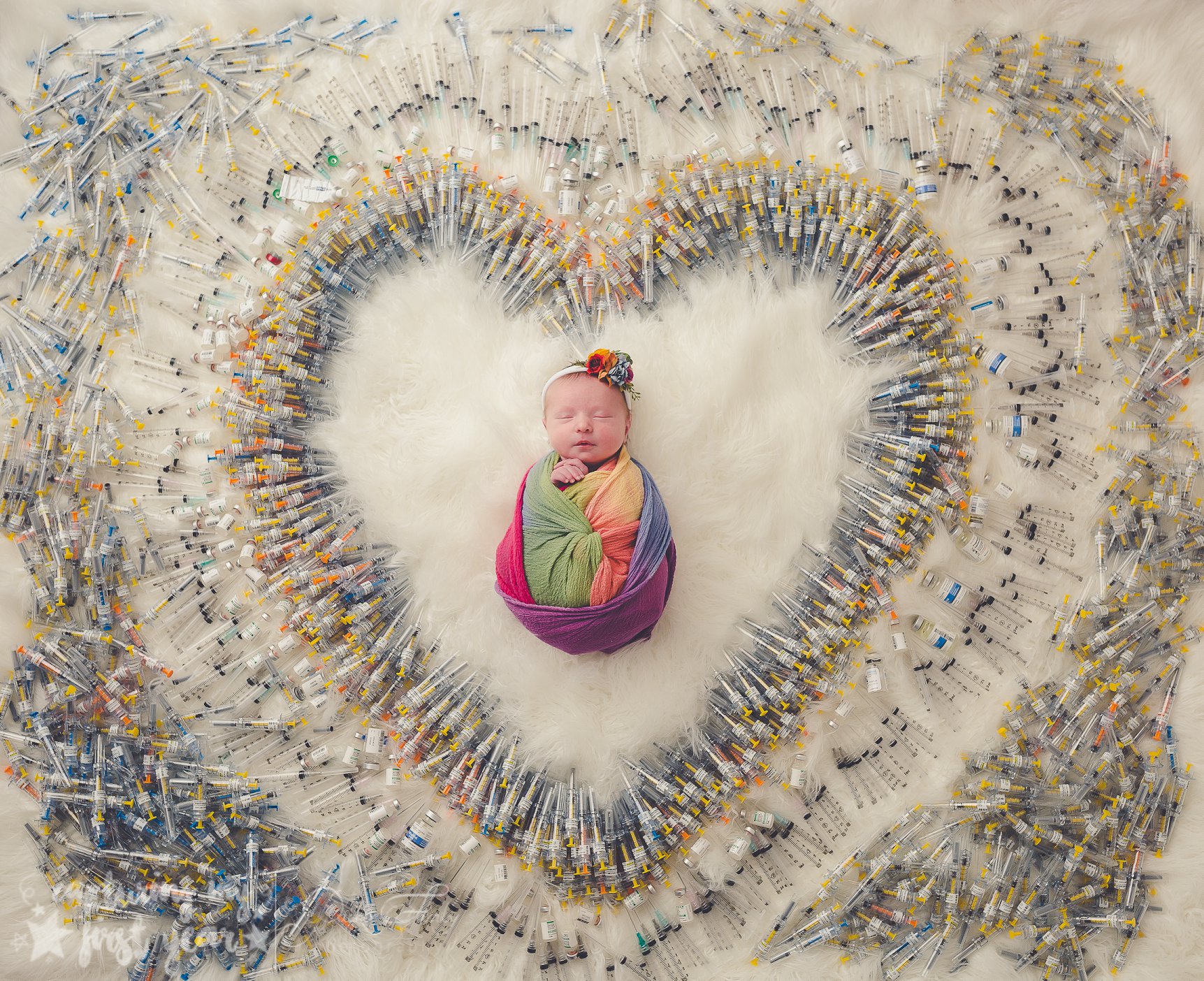
Some drive long distances in the wee hours of the morning, even in the middle of snowstorms, to make it to their appointments, and then head into work. Some bear the 30 to 90 injections an IVF cycle demands, as captured in this photo of a 2-week-old and the 1616 needles her mom used during her fertility journey.
Toronto-based mom and content creator Karthika Sivaloganathan now openly talks about her nine-year fertility journey, and a mistake she made on that front.
I went back to work after I had a miscarriage. I thought I could keep going, pretend like everything was okay, but I wasn't okay,” she said. “I was in pain and emotionally I was completely drained and there I was trying to go to meetings and talk to my colleagues, and do my work like nothing happened. No one talks about these things openly at work, and I really wish I could have asked more questions and given myself permission to rest.
Sivaloganathan has some advice for working women: “Check your benefits, take the time you need, and know that protecting your mental health is not a sign of weakness."
A WOMAN'S BURDEN
In some Tamil families, a woman bears the burden of infertility. The expectation is, first comes love, then comes marriage, then comes a bevy of kids. “What’s wrong with her?” people whisper, not as quietly as they should, if they should at all. These comments can impact a woman’s entire sense of self.
Lavana* said her mother-in-law would cry randomly when she saw her because they didn’t have children. Some people stopped inviting her to bridal showers or valaikkappu ceremonies, When she didn’t appear pregnant, she heard gossip wondering if she and her husband were breaking up.
When it all got too much, I stayed away from places to preserve myself, she said.
A common theme in the stories we read is the effort women make to outwardly pretend all is well while enduring invasive treatments and bumps in the road.
Sanjana* described what happened right after getting the news from her doctor that her latest round of IVF was a failure.
I took the news in stride and thought I was ok. I called my partner, broke the bad news to him and said I was fine,” she said. “I was driving home and then it hit me, this wall of grief, I pulled into a parking at at a strip mall, called my friend and we cried together for an hour.
BAD FOR WOMEN, BAD FOR SOCIETY
The stigma shrouds a very real statistic. According to the Canadian Fertility and Andrology Society, one in six Canadian couples experience infertility. Medically speaking, infertility is diagnosed as the inability to conceive naturally after a year of trying.
The silence in the Tamil community means women and their partners put on a brave face while enduring deep isolation around complicated medical journeys, the financial strain of multiple procedures and the fear of failure. Even worse, they are unprepared for the emotional trauma of unfavourable outcomes like miscarriages and vague results.
Nandhini* wrote to us about the painful aftermath of a recent diagnosis of unexplained infertility:
I was prepared to receive a more definitive explanation as to why things weren't working. Instead, I was left with even more questions,” she said. “This moment made me feel inadequate and incapable.
This isn’t just about hurt feelings. The stigma means many couples miss out on the range of treatments available to them and Canadian society misses out on addressing the problem of record-low birth rates in the country. Access to timely, tailor-made and trustworthy resources is critical to women’s health and welfare. It is also good public policy.
With advancements in assisted reproductive treatments and family planning programs, there are a lot more options for women trying to start or grow their families. These include everything from tests to identify issues to medication to regulate cycles, IUI, IVF, surrogacy and adoption.
IUI or Intra-Uterine Insemination involves inserting sperm directly into the uterus. IVF or In Vitro Fertilization is the process of fertilizing an egg with sperm outside the body, in a lab. Surrogacy is leaning on another woman to carry and deliver the baby.
Costs for treatments can range from $500 for an IUI cycle to $20,000 for an IVF round. There are tales of Tamil couples remortgaging their homes and spending up to $100,000 on multiple treatments.
Fertility is big business in Canada. The industry was valued at $1.5 billion in 2022 and is expected to grow to $2.72 billion by 2030.
LEARN AND SHARE
To shed light on this unspoken issue, our non-profit, Tamil Women Rising, is holding an event focused on fertility and the working woman, for women navigating careers, ambition and the complexities of fertility.
On June 7th, we hope to inform and inspire women to seek the knowledge, resources, and support to confidently navigate their fertility, reproductive health, and career planning.
We have an incredible roster of Tamil and South Asian experts speaking that morning:
Dr. Prati A. Sharma Fertility Doctor and Reproductive Endocrinologist
Dr. Chaula Mehta, Fertility Doctor and Reproductive Endocrinologist
Dr Shamini Kirupa, Obstetrician and Gynecologist
Geetha Phillipupillai, Employment Lawyer
Diwany Selvarasa, Social Worker and Therapist
Viveka Ramesh
Abhi Arulanantham
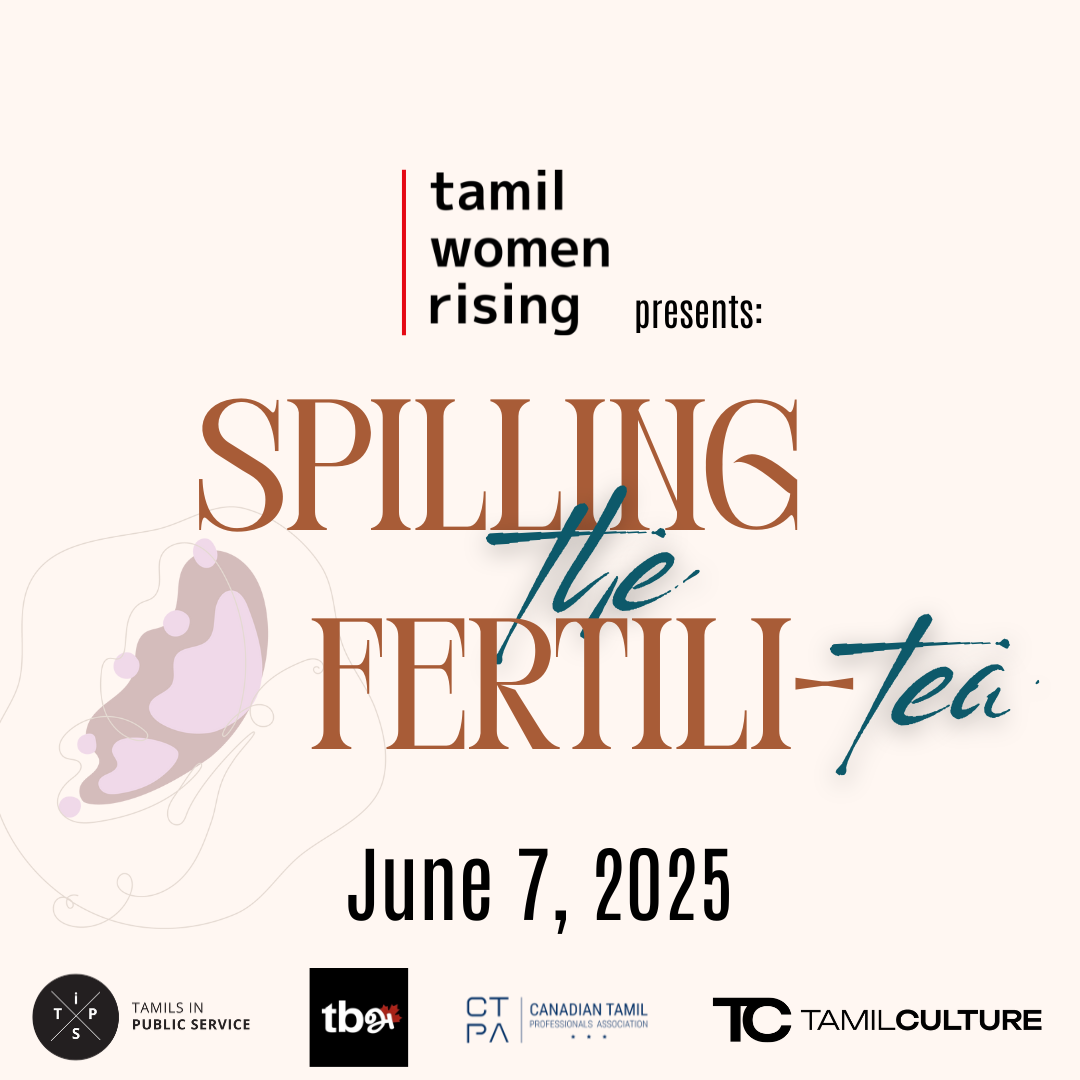
Date: Sat June 7, 2025
Time: 9:30am - 1:00pm
Place: Burrows Hall Community Centre
Get your tickets here: https://www.eventbrite.ca/e/spilling-the-fertili-tea-tickets-1357725496509?
Let us stop asking, “Any good news?” and start asking, “How can I support you?”
Let us honour the strength of women who endure this journey.
And let us remind every woman facing these struggles that they are not alone, that their story matters, and that these outcomes are not a measure of their worth.