


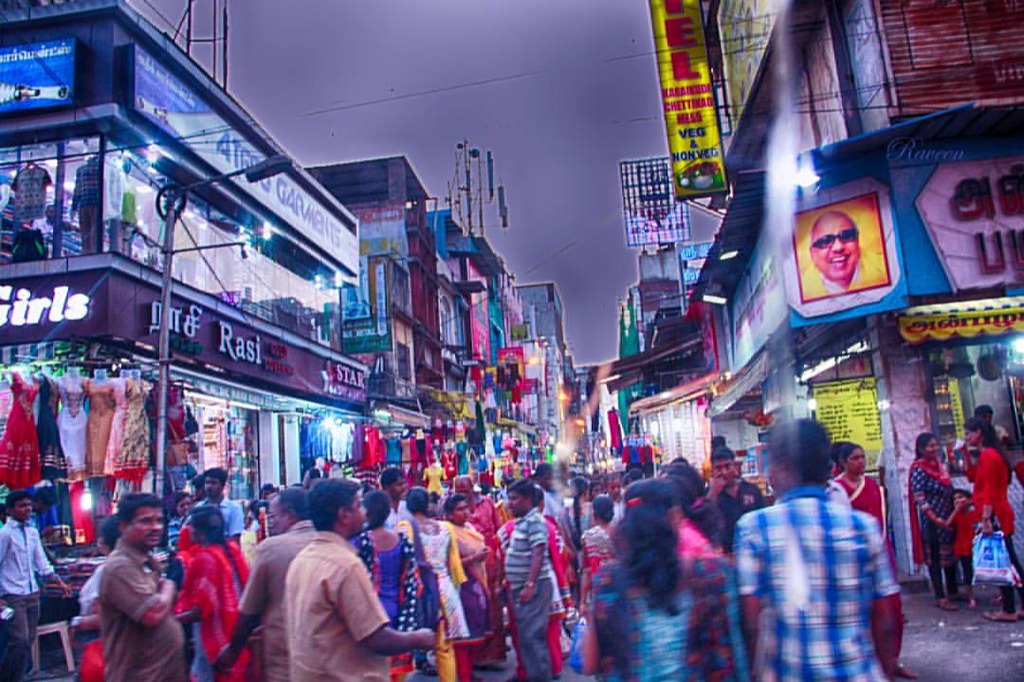
A visit to T. Nagar in Chennai—the saree capital of the world—is enough to give you goosebumps. It’s one of the busiest commercial districts in Tamil Nadu. Step into any saree shop, and you're likely to hear conversations in Sri Lankan Tamil accents. Start chatting, and you'll discover they're from Canada, the U.S., the U.K., France, Switzerland, or Australia—Tamils who once migrated from Sri Lanka and now visiting India during their Sri Lanka visits.
For Tamil families in the diaspora, visiting India is often centered around two rituals: temples and saree shopping. While the women spend hours browsing exquisite silks, the men can usually be found searching for the nearest chair, phones in hand. (That’s me, by the way—if you’ve ever spotted a guy sitting quietly in a corner, that’s likely Siva, temporarily defeated by the sheer volume of fabric options.)
Talk to any shop owner, and they’ll tell you: at least 30% of their business comes from the diaspora. One local tour driver summed it up perfectly:
“I’ve been driving for 25 years. My two children are in college—one studying computer science, the other medicine. Every rupee I’ve earned is from people visiting from Canada, the U.S., and Europe. And they treat us well. I’m lucky, Anna(brother).”

The impact is real—and massive. The same story holds true for local hotels. A hotel manager told me that 30% of their clientele are Tamil diaspora.
India is now one of the fastest-growing economies in the world and is expected to become the third-largest by GDP—projected to reach $7 trillion. Unlike many Western economies built on large corporations, India's growth is powered by millions of small businesses, including these family-run saree shops. In fact, some of these small businesses are now going public.
The saree shopping experience itself is uniquely Indian. Take Varalaxmi Silks, for instance.
To enter, you first remove your shoes. You sit cross-legged on the floor while a saleswoman patiently displays saree after saree in a ritual that often lasts hours. Some shops even perform a small Pooja (Hindu prayer) before you leave with your purchase.
While my wife was busy buying sarees for what felt like the entire state of New Jersey, I—Siva—was once again in corner-chair mode, my brain quietly switching into entrepreneur mode.
A bit of Googling (and a quick ChatGPT check) revealed something fascinating: this “small” store chain is publicly traded on the Indian stock exchange. It generates $120 million in annual revenue and $7 million in profits, with a market cap of $280 million.
And there are hundreds of thousands of such businesses across India.
India, particularly Tamil Nadu is rising, yes. But it’s rising on the shoulders of small businesses.
And the diaspora? They're driving at least 30% of it.


