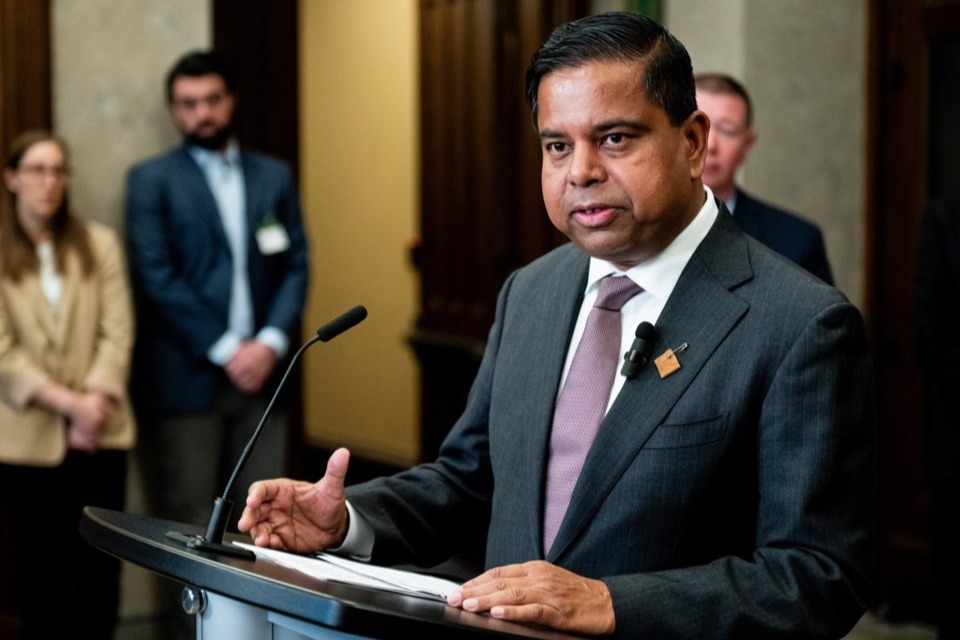
Gary Anandasangaree, a longtime Canadian Liberal MP and newly appointed Minister of Public Safety, recently announced that he was stepping back from taking any official policy positions on decisions concerning the LTTE and broader “Tamil community”, according to reports. It is noteworthy that Anandasangaree decided to do this himself, as far as we know; he was not requested to do this by the prime minister or anyone else. But his reasoning for this move is surprising, and warrants a larger discussion about its broader implications and double standards that are undeniably at play.
The action of recusing himself from any national security decisions related to the Tamil community apparently came after questions were raised about Anandasangaree’s previous advocacy work for the Tamil community, and as an immigrant and member of the Tamil community himself; a conflict of interest screen, which is what Anandasangaree requested, “consists of a statement in which an elected official agrees to abstain from any discussions, decisions, debate or votes concerning the matter that forms the subject of the conflict of interest” (Global News). In Anandasangaree’s case, this apparently extends to the LTTE and the World Tamil Movement, to “ensure there is no perception of any conflict.”
With Anandasangaree’s previous work with the Tamil community, some journalists have raised doubts about his ability to be impartial in his job of enforcing public safety; this is noteworthy for a few reasons.
Firstly, it ignores the fact that Ministers are usually appointed precisely because they have expertise in their area of responsibility. Canada’s former defence minister, Harjit Sajjan, was an officer in the Canadian army; Rebecca Chartrand, Canada’s current Minister of Northern Affairs, has a background in indigenous education and advocacy; Anandasangaree’s knowledge of the refugee and migrant landscape and his own immigrant background make him, at the very least, qualified for his role, rather than a hindrance to fulfilling his mandate. Mark Carney himself, as a former banking and Goldman Sachs executive who has spent most of his career working to advance the interests of big finance, will undoubtedly not be expected to recuse himself from decisions impacting these giants, no matter any scrutiny he may come under. Whether this scrutiny is warranted or not, it should be applied equally, not just to specific ministers.
Secondly, the suspicion that Anandasangaree’s ethnicity and previous work makes him sympathetic to the Tamil community and a “strong border” is notably not a suspicion that is applied to his colleagues, who you could argue have some blatant conflicts of interests impacting their ability to “objectively” do their job. The most evident example of this is Chrystia Freeland, Canada’s former Deputy Prime Minister and Minister of Finance, and current Minister of Transport. Freeland is of Ukrainian heritage, has lived in Ukraine, and has advocated openly for Ukrainian causes before she entered politics. As Deputy PM, Freeland played a leading role in pushing for the freezing of Russian assets in Canada after the Ukraine war began, and for the billions of dollars Canada has given to Ukraine in direct aid. While this conflict of interest seems very bare and obvious, Freeland has not faced much public scrutiny for her ties to Ukraine, and how this may have impacted her critical role in these major policy decisions. On the contrary, media reports have leaned into her ties to Ukraine and presented them as admirable, as this quote from a Politico article makes clear:
“The pursuit is personal for the granddaughter of Ukrainian immigrants. A native of rural Alberta, where ties to Ukraine run deep, Freeland has been a major booster of Ukraine’s war effort. She regularly speaks and texts in Ukrainian with top officials in Kyiv. She also snaps at Russians in their mother tongue.” In the war’s early days, she spoke many times daily with Ukrainian Prime Minister Denys Shmyhal. “What can I do?” she asked on day one. “I told her about operational needs,” Shmyhal told POLITICO in a written statement. “Our needs of weapons, and what kind, [our] need of funding.” Freeland’s typical response: “I am working on it.”
The passage above shows that Freeland made personal commitments to help Ukraine’s government, driven by her personal ties and care towards the Ukrainian community, leading to billions in taxpayer money being sent overseas. If Gary Anandasangaree’s advocacy for the Tamil community has raised so many eyebrows that his suitability for Minister of Public Safety has been called into question, Freeland’s Ukrainian background should have raised alarm bells.
Of course, there are some differences between the two cases. Maybe there’s more political will in Canada to stand up for Ukraine than for other immigrant communities. The LTTE are also a banned organisation in Canada; but Anandasangaree has never been a member of that organisation. So why does he need to recuse himself from any decisions related to the Tamil community? Unless we’re saying the LTTE and the Tamil community are one and the same thing (which they are not), his ethnicity and previous experience are an asset to understanding the communities he will be working with as Minister of Public Safety. What this double standard actually reflects is that certain immigrant communities are simply seen as less favourable than others; where Anandasangaree’s ethnic and professional background are labelled a liability on ‘Tamil issues’, Freeland’s ethnic and professional background are seen as a strength when dealing with Ukraine.
Regardless of the geopolitics that influence these perceptions, the point is that the standards and scrutiny to which we hold politicians accountable to should be equal, regardless of which communities they come from. Whether the consequence is billions of dollars spent or public safety concerns, if people are going to make the argument that a politician's ethnic or professional background will negatively impact their ability to serve Canadians, the scrutiny must be applied to everyone across the board.
https://www.politico.com/news/2024/03/17/chrystia-freeland-russia-ukraine-sanctions-00143013