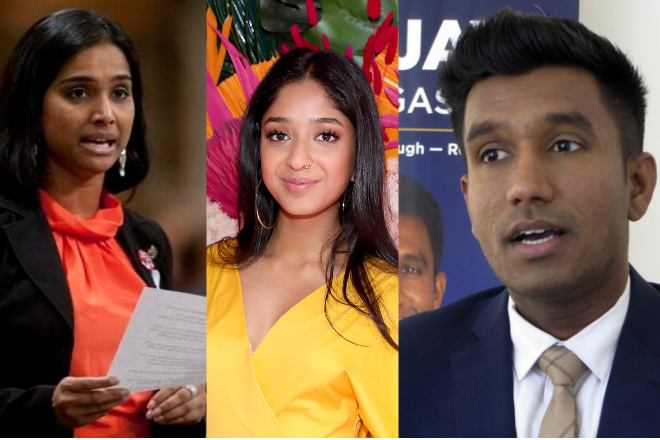
“The first Tamil woman to star in a Hollywood film”. “The first Tamil MP in Canadian history”. “The first Tamil comedian to sell out a major North American venue.” “The first Tamil artist to win a Juno Award.”
As the global Tamil community continues to make strides in all kinds of avenues, headlines of artists, politicians and athletes reaching new milestones are more and more common. Many of these people, as the “firsts” of the Tamil community, often see surges in media attention and following, especially from fellow Tamils who are inspired by their success and see them as trailblazers for others. While these accomplishments are a great step for Tamil representation and success, these figures often come under a microscope. They are branded as spokespersons for the Tamil community and for Tamil issues, and are expected to act as representatives for the community. Is this a fair expectation?

Examples of these expectations are numerous. Tamil-Canadian MPP Vijay Thanigasalam faced criticism in 2018 for previous posts he had made supporting the LTTE, and then faced further criticism for withdrawing his support for the group. In 2014, federal MP Rathika Sitsabaiesan faced both support and backlash for comparing November 27th’s Martyr’s Day with Remembrance Day observed on November 11. Actress Maytreyi Ramakrishnan and cabinet minister Gary Anandasangaree have similarly faced both praise for standing up for the Tamil community, and criticism for their perceived failures to represent the community well.
Maybe there is a case to be made that community trailblazers owe it to the Tamil people to speak on community issues; after all, public figures have a unique platform and ability to bring social issues to wider awareness, and many argue that they have a moral responsibility to take these steps. But there are several issues that come with holding these individuals to such a standard.
Firstly, the expectation that Tamil public figures must speak on Tamil issues assumes that these individuals are knowledgeable about these issues in the first place. Celebrities and artists may not be as attuned to the history and nuances of “Tamil issues” as observers often expect; they may have opinions on certain matters but may lack in-depth knowledge to make informed statements, especially statements that will be heard by millions around the world. While Tamil politicians in the diaspora may have more familiarity with community-specific issues by comparison, taking a specific stance on Tamil issues may conflict with their mandates and responsibilities as public servants. Tamil public figures have often taken very vocal stances on Tamil issues, which should be celebrated; but forcing everyone else to follow suit often places them in the uncomfortable position of speaking on issues they may know very little about, or may frankly not have strong feelings toward.
The second issue with placing such a responsibility on Tamil public figures is that it makes it impossible to determine the “correct” stance to take. Every action the individual takes becomes a statement of support or a statement of opposition to the community; if they wear a saree, they are not simply wearing it - they are making a statement about Tamil culture. But if they choose not to wear it, it may be seen as a snub. Do they say they are from Sri Lanka, or from Eelam? Do they say they are Tamil, or Sri Lankan? Every action comes under scrutiny, and will inevitably lead to backlash from one segment of the population or another.
But arguably the most damaging impact of the expectation for Tamil public figures to speak up, is that such pressure and scrutiny can often minimise the impact of their achievements. Rather than being held up as the true trailblazers they are, their success in the eyes of the community comes down to a checklist of approval that they cannot possibly win; holding them to such expectations and turning on them when they inevitably fail takes attention away from their achievements and the very success that we claim is so important for the Tamil community.
Not every Tamil public figure needs to take a stand as a representative of the Tamil community. The ones that do should be celebrated, but the ones that do not should not be branded as having turned their back on their people. Being famous comes with a certain level of responsibility, but not an automatic obligation to comment on social issues; Tamil trailblazers should be allowed to enjoy their successes and be celebrated for their accomplishments, without bearing an expectation to represent the entire community on the global stage.