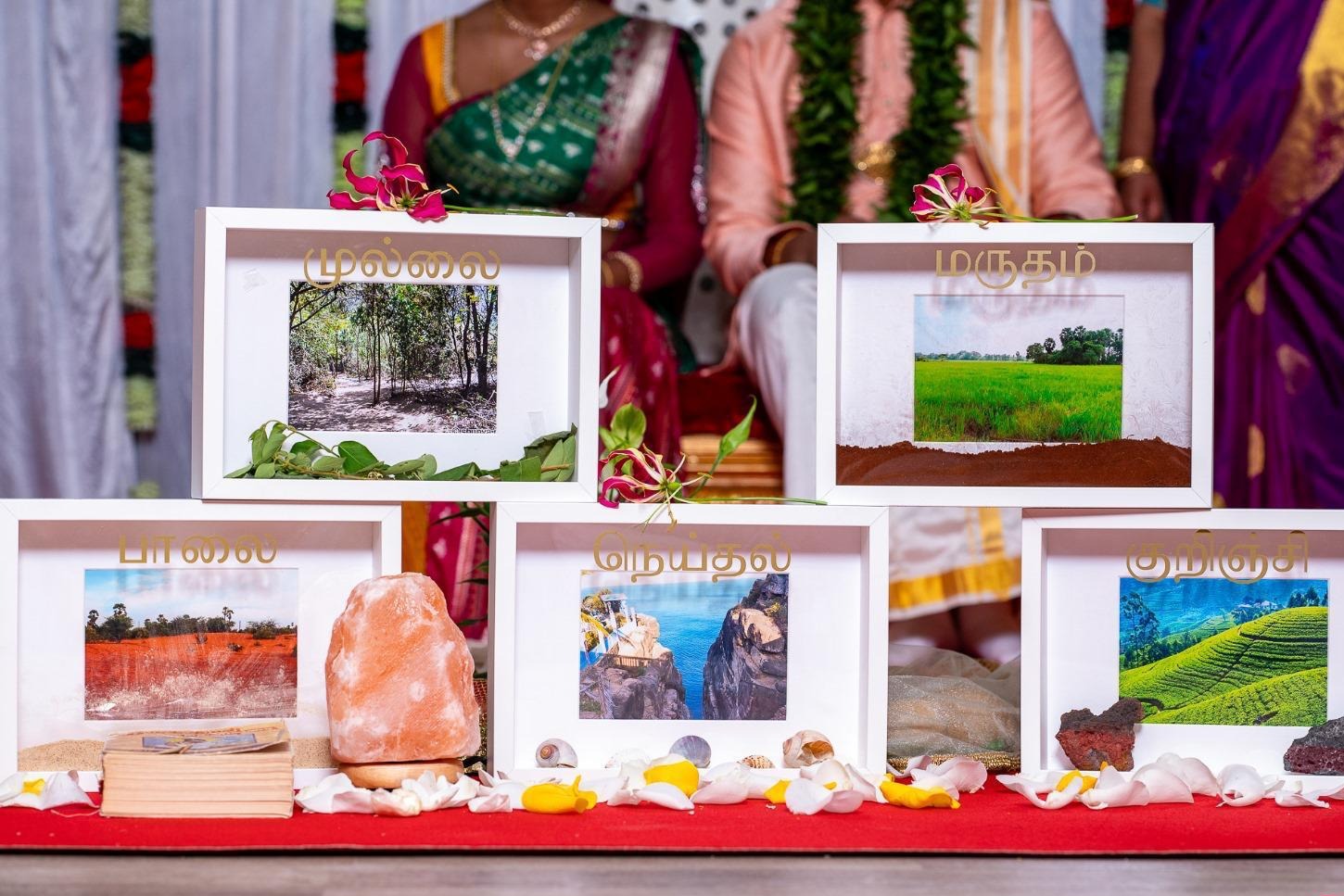
Today, I officiate Tamil indigenous weddings rooted in ancient customs and traditions. When I first began this work, I found myself asking a simple question: how did ancient Tamils get married, and what were these rituals really based on?
Rituals are never random. They reflect the values of a society. When I turned to Sangam literature, one thing became clear. Nature and Tamil life were inseparable. Sangam literature refers to a body of ancient Tamil poems, written over 2,500 years ago, that capture everyday life, love, governance, and the environment of early Tamil society. Through these poems, we see that ancient Tamils did not view themselves as above nature, nor did they believe nature existed to serve humans. There was a sacredness in how they understood the world around them. Human life was shaped by land, water, and seasons.
One of the most powerful frameworks comes from the oldest surviving Tamil literature we have today, Tolkāppiyam, which organizes life into five ecological regions, or thinais: kurinji (mountains), mullai (forests), marutham (farmlands), neithal (coasts), and pālai (arid lands). This was not just geography. It was a complete eco-centric system where land, people, emotion, occupation, and even divinity were interconnected.
|
Name (Thinas) |
Landscapes |
Lifestyle |
Flower Symbol |
Emotion of Love (Akam) |
|
Kurinji |
Mountains |
Hunting, gathering |
Kurinji flower |
Union (lovers meeting in secret) |
|
Mullai |
Forest |
Herding, cattle life |
Mullai (jasmine) |
Waiting, patience |
|
Marutham |
Agricultural land |
Farming |
Marutham tree |
Conflict, quarrel |
|
Neithal |
Seashore |
Fishing |
Water lily |
Longing for return of loved one |
|
Palai |
Desert |
Survival, journey |
Palai plant |
Separation |
Each landscape shaped how people lived, how they expressed emotion, and how they understood relationships. Tamil culture, as reflected in these texts, was deeply rooted in its environment. In my wedding ceremonies today, couples honour these five natural forces. It is a way of bringing this worldview into a modern context and grounding marriage within nature itself.
Early Tamil worship also reflects a relationship shaped by awe and respect for natural forces. Faced with floods, storms, and uncertainty, people sought to understand and live in balance with the environment around them. Water, in particular, held immense importance. Ancient Tamils understood it as essential to survival. In my ceremonies, alongside traditional offerings, families bring a pot of water, marking it as sacred and life-giving. There is also a beautiful early practice where a bride, entering her husband’s home for the first time, goes to the well and drops a betel leaf into the water. In that moment, she makes an oath not just to her new family, but to the water itself, asking to be accepted as a daughter and promising to protect that resource.
The importance of water preservation is captured powerfully by the female Tamil ancient poet Avvaiyar:
வரப்புயர நீர் உயரும்
நீர் உயர நெல் உயரும்
நெல் உயரக் குடி உயரும்
குடி உயரக் கோல் உயரும்
கோல் உயரக் கோன் உயர்வான்As the ridge of the field rises, its capacity to hold water increases;
As water increases, the paddy grows well;
As the paddy grows, the people prosper;
As the people prosper, governance is strengthened;
As governance is strengthened, the king rises to great prosperity.
In just a few lines, this poem shows how environmental care leads to agricultural strength, which supports thriving communities and stable governance.
Flowers, too, held layered meaning. They were used for beauty and decoration, while also representing love, war, peace, and identity. In marriage, one of the most consistent and enduring rituals has been the exchange of garlands. While there is ongoing discussion about whether the thali existed in ancient Tamil society, what remains clear is that the exchange of garlands symbolized the completion of marriage. Two individuals choosing each other through a natural element.In my weddings, this exchange is central as it is rooted in our indigenous tamil customs.
Even kings, celebrated in Sangam poetry, were at times remembered for how they treated nature. King Pāri is one such example. When he saw a jasmine creeper struggling to grow without support, he gave up his chariot so it could climb and reach sunlight, choosing care for a plant over possession of wealth. The significance of this is not just generosity. It reflects a worldview where nature was, at times, worthy of protection, attention, and respect, even from those in positions of power.
This Earth Day, perhaps the lesson is not about rediscovering something new. It is about remembering what our ancestors already understood. We are not separate from nature. We are part of it.
Sources:
Sangam Literature's Eco Epics: Ancient Tamil Reverence for Nature
(PDF) Treatment of Nature in Sangam Poetry
The Sweet Salt of Tamil by Tho Paramasivan
**To learn more about ancient Tamil customs and practices follow @whatthepottu.