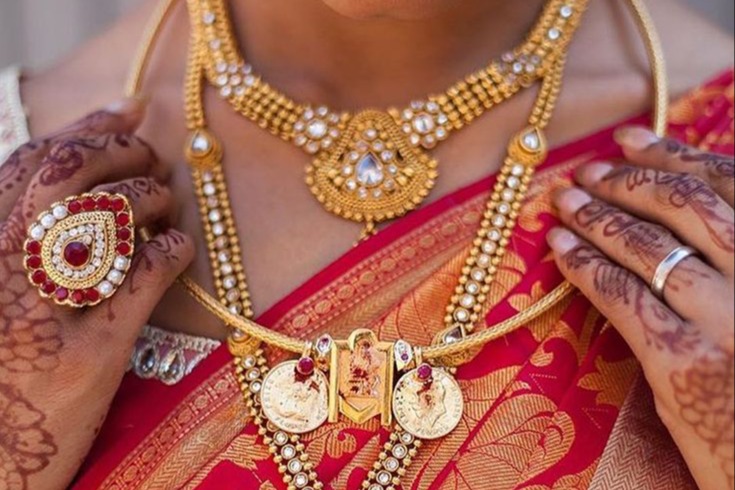
The Thaali wedding necklace that most Tamils are familiar with is often adorned with two gold coins on either side of the pendant. I was recently at a jeweler and learned something about the Thaali design that I did not know previously: it is common practice that each of the two coins have the portrait of the British queen and king on the back - queen Elizabeth and king George. When I asked the jeweller, she said it’s been common practice since the time of her grandparents, and before. Looking into the history of this practice, it sheds light into the ways in which colonialism perpetuated divisions in colonised communities in Asia and elsewhere - but things are changing.
Looking to meet your match? Connect with people looking for something meaningful - join myTamilDate!

It’s surprising, to say the least, that wedding jewellery rooted in centuries of tradition has become infused with such an obvious colonial influence. The practice of adding coins to the Thaali has been around long before colonialism, often as a display of wealth or prestige for the bride and groom’s families. The introduction of British coins into circulation under colonial rule created an easy-to-understand demand: British coins were not easily accessible and were of high value; having access to coins such as these for addition to the Thaali, whether through inclusion in upper class circles or through purchase, meant you were (or could signal) your status as a wealthy family.
Colonialism works in funny ways. It’s strange to think that symbols of an oppressive and destructive system could ever have been embraced in any way by the colonised; however, that is exactly how historic colonial policies were designed; they were designed to give specific groups privilege and societal elevation, at the expense of the others. Through such a system, one group would always have an interest in maintaining the status quo in some form; while they were still oppressed, they were at the top of the colonised hierarchy and reaped certain benefits. I’ve written in the past about how colonisation perpetuated community divisions and often pitted communities against one another in Sri Lanka. This was done for a simple reason: if a population was preoccupied with resentment and competition between each other, less anger was directed at the colonial ruler.
With the benefits that came with being near the top of the colonial hierarchy, the more likely you were to reap the benefits and therefore showcase your ability to obtain them. It is well-known that the Tamil community in colonial Sri Lanka was in this privileged position, whether people like to accept this or not. The class divisions intentionally created by colonialism may in part explain why a subjugated community may have celebrated its ability to obtain colonial symbols of status and display them proudly, rather than reject them as oppressive and invasive, whether it be British coins, English education, Christianised identities, or missionary education.
Modern interpretations of the Thaali have definitely changed; the jeweller I spoke to said more and more couples today are rejecting the inclusion of British royalty on their Thaalis, choosing instead to go with symbols of Hindu gods and goddesses in their place. With today’s understanding of the ways in which colonialism destroyed homes and communities, the reclamation of the Thaali’s cultural value, free of British influence, is a logical step in the right direction.
References
-
https://www.aljazeera.com/opinions/2017/8/10/the-partition-the-british-game-of-divide-and-rule
-
Soherwordi, S.H.S (2010). Construction of Tamil and Sinhalese Identities in Contemporary Sri Lanka. Pakistan Horizon, 63(3), 29-49.
-
Lin, David, "The Role of British Colonial Policy in the South Sudanese Civil War: A Postcolonial Conflict Analysis (2018)" (2018). International Studies Undergraduate Honors Theses. 26. https://scholarworks.seattleu.edu/intl-std-theses/26
-
What Policies Cannot Express: An Examination of Sri Lanka’s Continuing Inability to Bridge the Sinhala-Tamil Ethnolinguistic Divide through National Policies and Programs. Bowdoin College. https://core.ac.uk/download/pdf/214030152.pdf
-
https://moderndiplomacy.eu/2021/03/20/politics-of-ethnicity-sri-lankan-case-study/